
TokenPost.ai
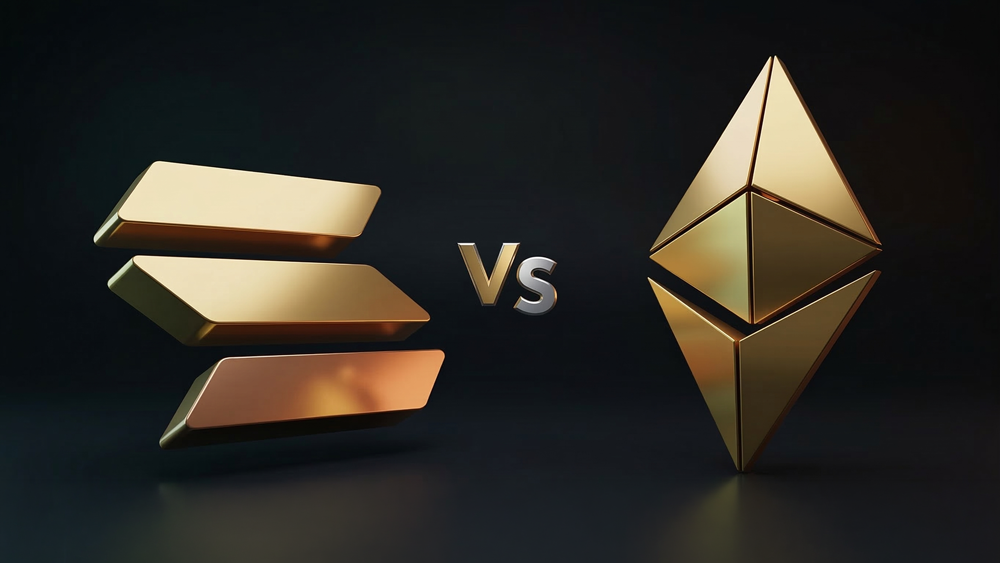
Ethereum (ETH) is widening its lead over Solana (SOL) in the race for on-chain fee revenue, underscoring a shift in what the market is paying for: not sheer transaction volume, but the settlement of higher-value financial activity tied to Layer 2 scaling and real-world asset (RWA) tokenization.
On the latest on-chain data cited in the report, Ethereum generated about $7.15 million in fees over the past 24 hours, up 1.4% from the prior reading. Solana posted roughly $4.06 million over the same window, down 3.5%. The gap becomes more pronounced over longer periods: Ethereum’s seven-day fees totaled about $58.95 million versus Solana’s $39.37 million, while 30-day fees reached approximately $317.68 million compared with Solana’s $180.20 million—around a 1.76x advantage for Ethereum on the monthly measure.
Market watchers increasingly view the divergence as structural rather than cyclical. Ethereum’s scaling stack has pushed the bulk of activity onto Layer 2 networks—where transactions are processed cheaply and in high volume—while still routing final settlement to Ethereum’s base layer. That design concentrates value at the point of L1 finality: batches are posted, proofs are verified, bridges are used, and data availability is paid for. In effect, Ethereum is optimizing for ‘fewer settlement events, more value per settlement event,’ a model that can increase fee capture even if much of the day-to-day user activity occurs off the main chain.
A key accelerant, according to the analysis, is the reinforcing loop between ‘L2 + stablecoins + RWA.’ Circle’s USDC ecosystem is described as a pivotal rail for tokenized finance, particularly for settlement in tokenized U.S. Treasury bills and commodities-linked instruments. As more RWA issuance and secondary activity leans on USDC as a settlement asset, demand rises not only for transactions on L2s but also for the L1 processes that make those transactions final and interoperable—bridging operations, oracle updates, and base-layer settlement. Each of those steps can generate fees that accrue to Ethereum’s economic layer.
That flow can be summarized as a pipeline: expanding RWA issuance drives higher USDC settlement demand, which increases L2 transaction throughput, which in turn raises the frequency and value of L1 settlement events. In this framing, L2s are not merely a cost-reduction tool; they function as a ‘revenue amplifier’ by aggregating activity and monetizing finality at the base layer.
Solana, by contrast, is portrayed as running into a margin problem rather than a performance problem. Its architecture is built for high throughput and low latency, which has made the network a natural venue for memecoin trading, high-frequency activity, and smaller-ticket DeFi transactions. But the same low-fee, high-volume approach can limit fee revenue per unit of activity—exposing a model where rising usage does not translate proportionally into higher on-chain income. In traditional finance terms, the report likens Ethereum’s profile to a higher-margin ‘investment bank’ model—complex, value-dense financial contracts—while Solana resembles a lower-margin ‘payment network’ built on scale.
The time-series data strengthens the case that this is not a one-off dislocation. The fee advantage persists on both the weekly and monthly windows, and the report argues the spread widens as the measuring period extends—consistent with ‘sticky’ capital moving into recurring settlement workflows rather than speculative bursts. Tokenized Treasury markets and institutional-style allocations are highlighted as especially important because they can generate repeatable, more predictable fee streams—often described as ‘real yield’—compared with the episodic revenue spikes seen in NFTs or highly volatile DeFi cycles.
That distinction may also carry valuation implications. If current revenue run rates are annualized, Ethereum sustains a materially larger revenue base than Solana, in the report’s estimates. Because RWA-linked activity tends to be less volatile and more persistent, the analysis suggests the market could apply a different premium to networks that capture that cash-flow-like profile, potentially feeding into a reassessment of valuation frameworks such as price-to-sales (P/S) ratios commonly borrowed from equities analysis.
Ultimately, the report frames the competition as a shift away from headline TPS benchmarks toward ‘where money is actually created and settled.’ Ethereum’s infrastructure is increasingly positioned as a high-value settlement layer for tokenized finance, while Solana remains optimized for fast, low-cost throughput. If tokenized assets and stablecoin-based settlement continue to scale, the battle for dominance may hinge less on raw usage and more on which chain becomes the default home for capital-intensive workflows—and, for now, Ethereum appears to be consolidating that role.
Article Summary by TokenPost.ai